From Foundations to Frontier: Where Our Lab Fits in Africa's AI Journey
Image: The DSFSI team at Deep Learning IndabaX South Africa 2026.
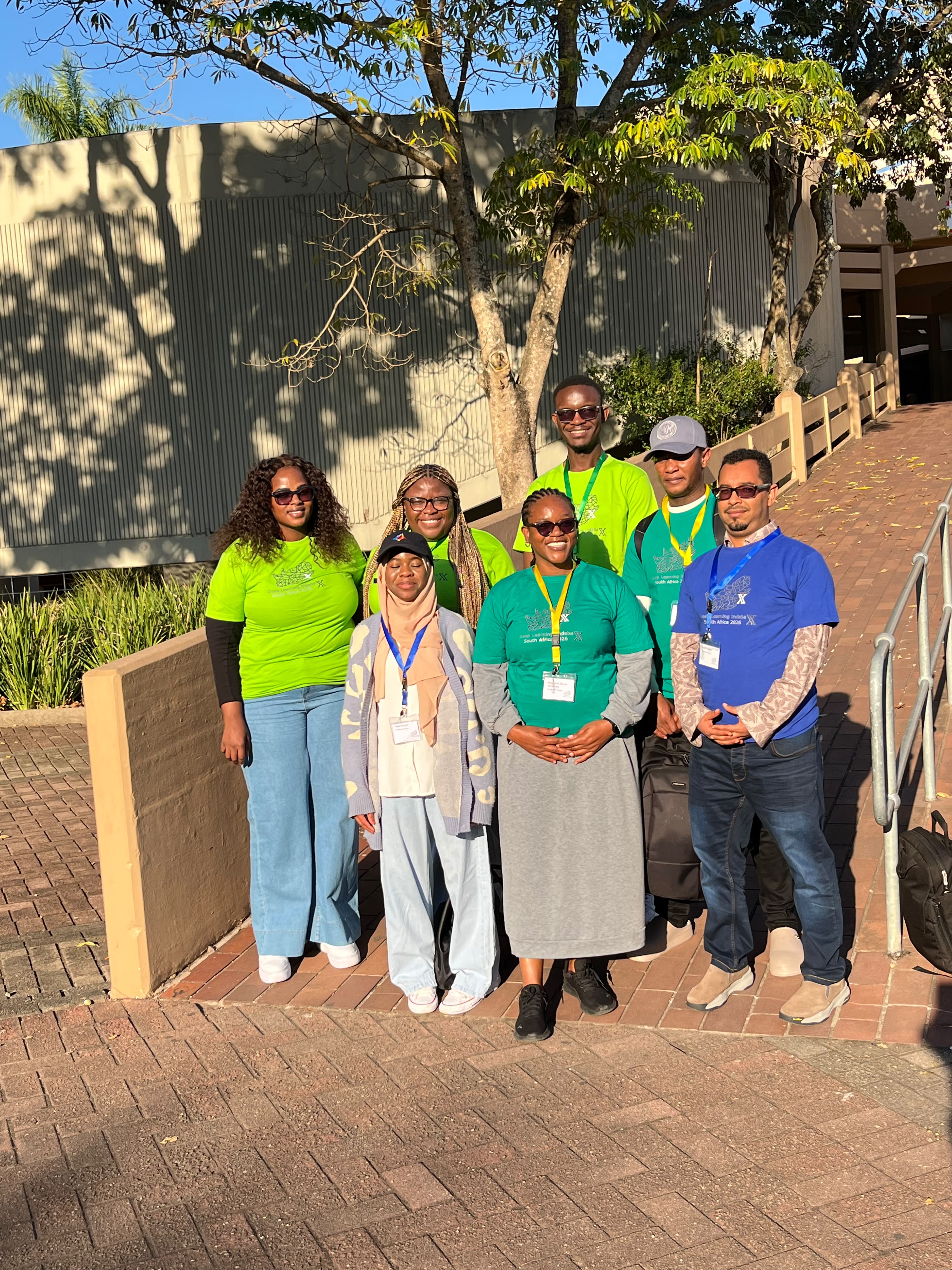
Image: The DSFSI team at Deep Learning IndabaX South Africa 2026.
Fiskani Banda, a PhD student supported by AI4D, reflects on the lab’s participation across Deep Learning IndabaX South Africa 2026, gathering takeaways from team members across the week.
When we talk about artificial intelligence in Africa, we aren’t just talking about models and data pipelines. We are having a much deeper conversation about trust, local context, and who gets to build the AI future for our communities.
One event that allows us to step outside our daily research and align as a growing community is Deep Learning IndabaX South Africa. This year’s theme, “From Foundations to Frontiers: Africa’s AI Journey,” served as a timely invitation to look back, take stock of our present, and envision the path ahead.
Across an action-packed week of keynotes, workshops, debates, and contributed talks, the program spanned the entire spectrum of AI advances, from fundamental building blocks to frontier applications across research, industry, and society at large. While revisiting the fundamentals was a grounding reminder of the core work that brought us here, the week also forced us to look forward and ask a crucial question: where does our own work fit into Africa’s AI future?
With this question in mind, our lab engaged across multiple roles throughout the week — running workshops, serving on the organizing committee, presenting research, and facilitating discussions. As we returned, each of us reflected on a single takeaway: what was our role this week, and how does our individual work contribute to Africa’s broader AI journey?
Voices from the Lab: Where Do We Fit In?
Looking across our team’s reflections, three strong themes emerge: reclaiming our voice, safeguarding the truth, and co-creating with communities. Here is how our lab members reflected on their roles and where their work fits into Africa’s evolving AI journey.
Reclaiming Our Voice: Language & Culture
Language isn’t just about communication, it is about identity, equity, and inclusion. This means moving from “imported models” to systems tailored for African contexts.
Dr. Abebe Tegene (NLP & Word Embeddings):
“Through the conference sessions, I explored emerging approaches for AI, particularly those that improve language technologies for underrepresented African languages. This experience reinforced my belief that Africa’s AI future depends on strengthening foundational research while developing innovative, inclusive AI solutions that enable local languages and communities to benefit from advances in artificial intelligence.”
Casper Muziri (ASR & LLM Fine-Tuning):
“African AI has struggled with data scarcity and a reliance on imported models that are not fit for our local contexts. Today, through LLM SFT our work addresses our current need to build and align language and speech models to handle local accents, code-switching, and indigenous languages. As highlighted in Dr. Combrink’s keynote on infodemiology, practical deployment requires multilingual reach and trustworthy communication to bridge technical research and public needs.”
Nontokozo Manukuza (Culturally Grounded LLMs):
“Attending the conference reminded me that Africa is not only adopting AI but is also shaping its future by building solutions that reflect our own languages, cultures, and communities. It was inspiring to learn from and engage with researchers and innovators who are working towards making AI more inclusive, relevant, and impactful across the continent.”
Thapelo Sindane (Inclusive AI Communication):
“By improving communication accessibility for Deaf communities, this work has the potential to transform sectors such as education, healthcare, public services, and entertainment. I believe it represents an important step toward a more inclusive AI ecosystem in South Africa and demonstrates how locally driven AI research can address underserved communities while contributing to Africa’s growing leadership in responsible and impactful AI innovation.”
Moyahabo Rabothata (Indigenous Language Math & Education AI):
“One can agree that Africa’s journey has not left me behind, which is what the community is about, taking people along the journey and shaping and building Africa’s AI future together. I believe my focus in building AI that speaks our languages has a place in where we are going as a continent, given that my focus is in Education and Mathematics which is a crucial subject for learners in Africa and South Africa.”
Safeguarding Truth: Trust & Responsible AI
Advanced AI systems cannot serve society if they amplify misinformation or fail basic safety standards. Building for the frontier means prioritizing verification and contextual safety.
Dr. Seani Rananga (Infodemiology & Information Systems):
“In an era where information spreads instantly, individuals can unintentionally become amplifiers of misinformation, making critical thinking more important than ever. IndabaX once again reminded me of the value of bringing together researchers, students, government, and industry to share ideas, collaborate, and build AI solutions that address real-world challenges. The conversations throughout the event reinforced the importance of responsible AI, trustworthy information systems, and interdisciplinary collaboration in shaping the future of AI in South Africa.”
Co-Creating with Communities: “By the People, For the People”
Technology isn’t built in an isolated lab; local communities must be co-creators at every step if it is to serve fields like agriculture, healthcare, and education.
Fiskani Banda (RAG & Agricultural AI):
“Co-hosting our RAG workshop and presenting alongside my team was such a highlight. It really made me step back and look at my own research with fresh eyes. Explaining these concepts to a fresh audience really highlighted how differently these systems perform when you bring them into our local, multilingual contexts. At the end of the day, it was a big reminder that if we want to build true frontier tech for Africa, we have to put our communities first and build tools that are genuinely personalized to our own African experiences.”
Hawa Ibrahim (Ecosystem Collaboration):
“I think my experience connects to how the development and inclusion, I guess, of AI in Africa and Africa’s ecosystems is not a problem solely for those with expertise in those specific areas, it’s an inclusive project that involves those with the expertise, community, students, corporate and international bodies etc, and I think we saw a small example of how that collaboration looks at IndabaX.”
Leaving IndabaX
Leaving IndabaX, we were reminded that every model we train, every dataset we curate, and every workshop we facilitate is part of a larger, collective story about African ownership in AI.
For anyone considering joining the IndabaX community, the advice is simple: get involved. Whether you are a student beginning your AI journey, a researcher sharing your latest work, or an industry practitioner looking to collaborate, IndabaX provides an exceptional environment to learn from experts, build meaningful connections, and contribute to a growing ecosystem dedicated to advancing AI responsibly.
As we look toward the future, we urge you to pause and reflect on your own role in this evolving landscape: where does your work fit on Africa’s AI journey, and how are you actively shaping it?
Follow our journey and beyond:
- DSFSI: https://linktr.ee/dsfsi
- AfriDSAI: https://linktr.ee/afridsai