AI4D Lab Visits Part 1: Sign Language and African Language AI at Maseno University, Kenya
PhD student Thapelo Sindane visits the Maseno Centre for Applied AI in Kenya to give a guest lecture, join a sign-language panel and share his SASL research.
Thapelo Sindane, a PhD student at DSFSI working on translation technologies for South African Sign Language (SASL), visited two AI research labs on the continent with sponsorship from the AI4D Africa programme. This first post covers his visit to Maseno University in Kenya. Part 2 covers KNUST in Ghana.
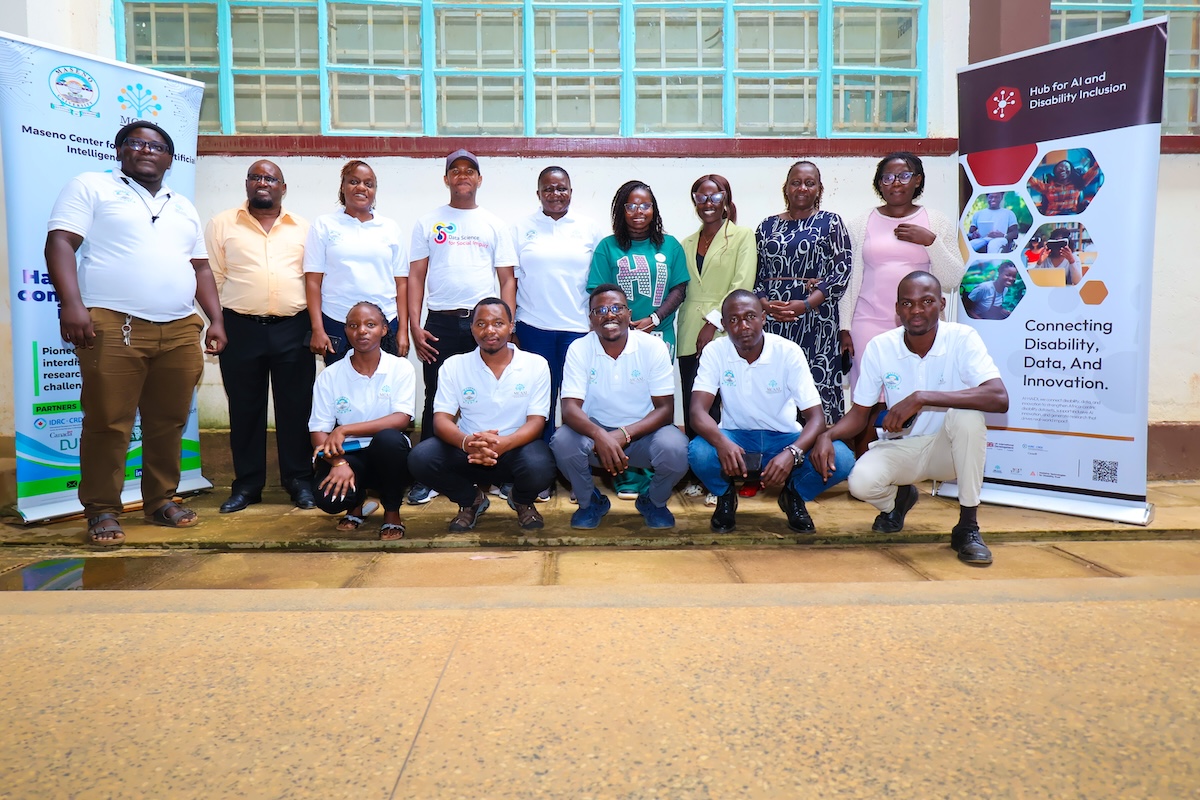
Thapelo with the team at the Maseno Centre for Applied Artificial Intelligence (MCAAI), Maseno University, Kenya.
Motivation for the Visit
As part of ongoing efforts to strengthen research collaboration, knowledge exchange, and capacity development in Artificial Intelligence (AI) across Africa, I undertook academic and research visits to Maseno University in Kenya and Kwame Nkrumah University of Science and Technology (KNUST) in Ghana. These visits, sponsored by the AI4D Africa programme, provided an opportunity to engage with research laboratories working on AI, natural language processing, machine learning, accessibility technologies, and, importantly, technologies aimed at supporting Deaf, hard-of-hearing, and other underserved communities.
The visits were particularly relevant to my doctoral research at the University of Pretoria - Data Science For Social Impact (DSFSI) Lab, which focuses on developing translation technologies for South African Sign Language (SASL). Beyond the technical exchange, the visits provided an opportunity to discuss responsible and ethical approaches to data collection, community engagement, and the development of AI systems for African languages and communities.
Visiting Maseno University, Kenya
My first visit was to the Maseno Centre for Applied Artificial Intelligence (MCAAI) at Maseno University, led by Dr Lilian Wanzare. I was particularly motivated by the Centre’s growing research activities in Kenyan Sign Language (KSL), which closely align with my own research on SASL. This provided a valuable platform for exchanging knowledge and experiences between researchers working on sign-language technologies in different African contexts.
The Centre’s research activities encompass a broad range of areas relevant to the development of AI for African languages and communities, including:
- Kenyan Sign Language research, led by Ezekiel;
- Machine translation for low-resourced Kenyan languages, associated with Kamau;
- Synthetic speech-data generation, associated with Edwin;
- Text-to-speech technologies;
- Automated speech recognition, associated with Cynthia;
- and several other projects.
The diversity of these activities demonstrated the Centre’s commitment to developing AI technologies that address local African challenges and language needs.
Guest Lecture and Panel Discussion
During the visit, I delivered a guest lecture entitled “Introduction to Machine Learning” to a diverse audience of undergraduate and senior postgraduate students. I designed the lecture to balance foundational machine-learning concepts with the more advanced mathematical and computational ideas underpinning contemporary language and vision-processing systems. I aimed to tell a coherent story from early perceptrons and foundational neural-network models through to contemporary attention-based architectures and Transformers, providing an accessible introduction to the models increasingly applied to language, speech, and sign-language processing.
In addition to the lecture, I participated in a panel discussion focused on the challenges faced by sign-language communities and the development of technologies that can address these challenges in an ethical and responsible manner. Facilitated by Cynthia, the panel provided an opportunity to discuss issues extending beyond technical performance, such as:
- Meaningful community participation;
- Responsible data collection and representation;
- Privacy;
- Ensuring that technologies developed for Deaf communities genuinely respond to their needs.
The discussion reinforced the importance of treating sign-language technology as a multidisciplinary and community-centred research problem rather than solely as a machine-learning challenge.
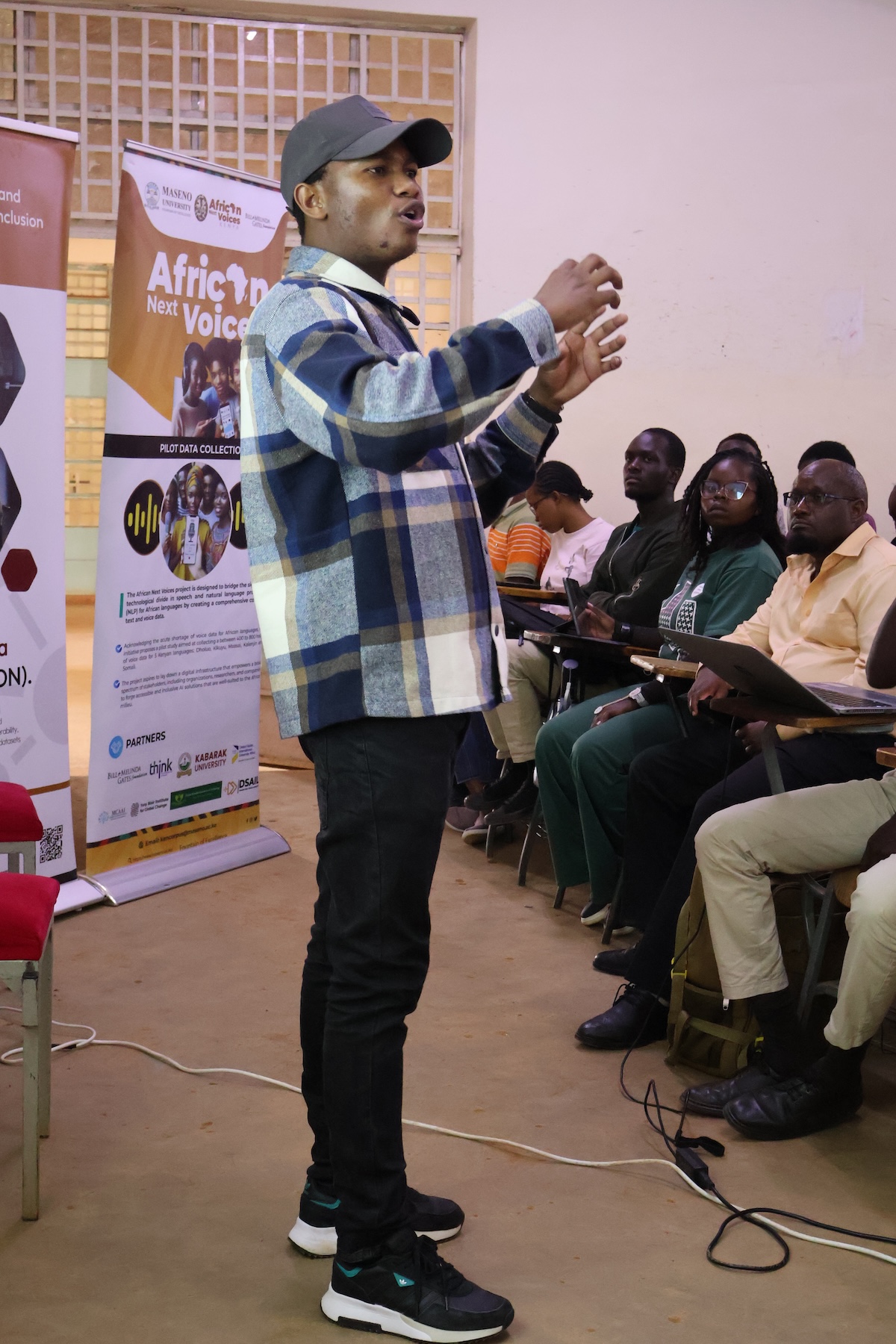
Thapelo speaking to students and researchers at MCAAI.
PhD Journey and Research Presentation
I also presented an overview of my PhD journey, including the progress made to date, the research challenges encountered, and areas where stronger collaboration could accelerate the work. My presentation included a discussion of my published literature review, “Transformers for sign language processing: A survey of spatio-temporal modeling approaches, challenges, and research gaps” (Intelligent Systems with Applications, 2026), which examines the application of Transformer-based approaches to sign-language processing.
I further explored prospective research directions, particularly methodologies for collecting sign-language corpora in a frugal and scalable manner without compromising data quality. This is particularly important for African sign languages, where the availability of large, high-quality datasets remains a major limitation to the development of competitive AI systems.
Overall, the Maseno visit provided a valuable opportunity to exchange knowledge with researchers working on closely related problems. The similarities between the challenges encountered in Kenyan Sign Language and South African Sign Language suggest significant potential for future collaboration, particularly around dataset development, modelling approaches, ethical research practices, and the sharing of methodological expertise across African sign-language research communities.
In Part 2, I write about my visit to the Responsible AI Lab at KNUST in Ghana.
Follow our journey:
- DSFSI: https://linktr.ee/dsfsi
- AfriDSAI: https://linktr.ee/afridsai