Reflections from the Society 5.0 Doctoral Consortium: From Technical Pipeline to Research Artifact
Image: Miehleketo Mathebula presenting his doctoral research at the Society 5.0 Doctoral Consortium.
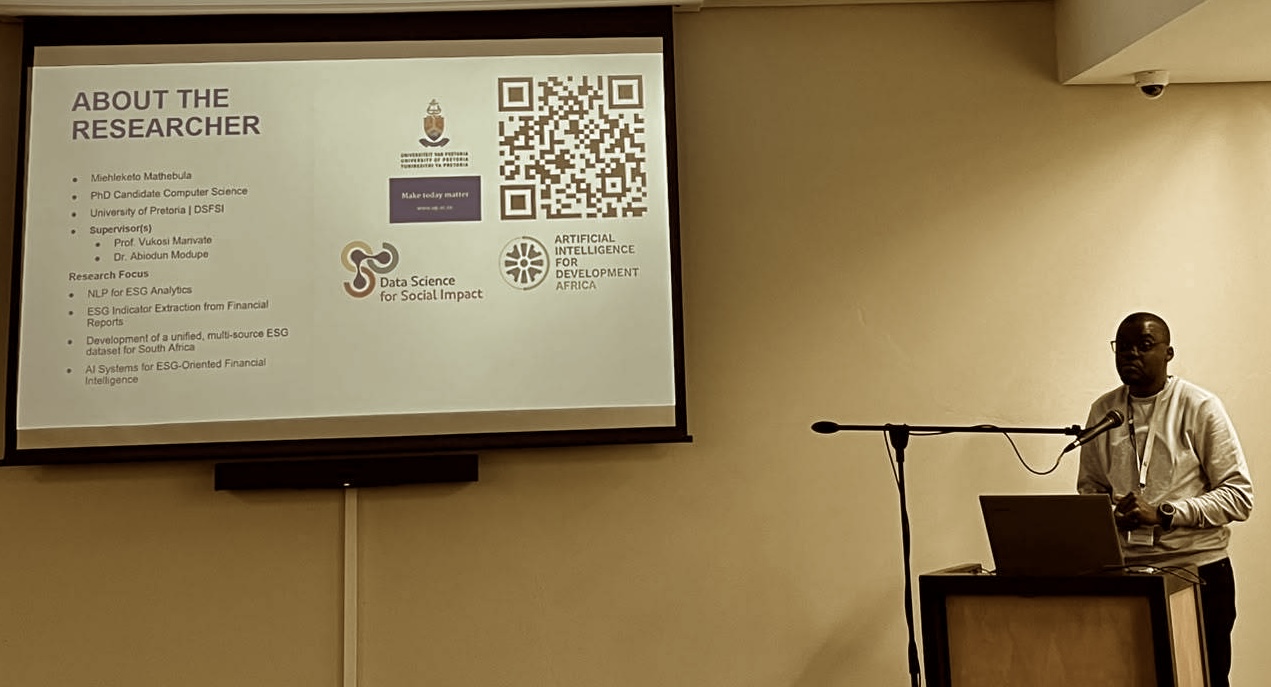
Image: Miehleketo Mathebula presenting his doctoral research at the Society 5.0 Doctoral Consortium.
On June 28th, during the Society 5.0 Conference 2026, DSFSI PhD candidate Miehleketo Mathebula participated in a unique doctoral symposium held against the scenic backdrop of Kruger National Park. The event provided a rare opportunity for deep academic mentoring and high-level technical critique, framed by a dual-perspective feedback structure: each presenter was evaluated by a two-supervisor panel—one specialist from their direct field and one from an entirely different academic background.
The Research Context: SA-FINESG
Miehleketo presented his doctoral work focused on SA-FINESG, an AI-enabled framework designed to provide ESG (Environmental, Social, and Governance) financial intelligence for South African and emerging markets.
His research addresses a critical bottleneck in the current landscape: ESG information is often fragmented across corporate reports, policy documents, and sustainability disclosures. The goal of his work is to transform this scattered, unstructured data into structured, machine-readable, and policy-aware intelligence using a sophisticated combination of data engineering, NLP, transformer-based models, retrieval mechanisms, and knowledge graph representations.
The Pivot: Embracing the Research Artifact
A defining moment of the symposium was the shift from viewing his work as a “technical pipeline” to framing it as a robust research artifact. While the initial focus was on the system’s ability to collect, clean, and process data, the panel encouraged a deeper theoretical positioning rooted in an adapted Design Science Research (DSR) approach.
The feedback highlighted several critical dimensions for elevating the contribution of SA-FINESG:
- Design Logic over Functionality: The framework must do more than show what it does; it must explain the underlying design logic and the “why” behind the architecture.
- Systemic Coherence: The research must demonstrate how the data pipeline, unified dataset, transformer models, retrieval layer, and knowledge graphs work together as one coherent contribution to the field of financial intelligence.
- Expanded Evaluation: Beyond mere model accuracy, the framework must be evaluated on data quality, traceability, explainability, and policy relevance.
- Dynamic Relevance: A key piece of feedback was the integration of a retrieval mechanism. This ensures the system remains relevant as ESG policies evolve and new documents are published in real-time.
This shift ensures that Miehleketo’s thesis stands as both a technical solution and a theoretical contribution to how we handle complex, high-stakes data in the South African context.
The Kruger Experience: Connection Beyond Academia
Beyond the rigorous academic critique, the setting of the Kruger National Park provided an unparalleled environment for networking. The relaxed atmosphere encouraged open dialogue between PhD candidates, supervisors, and researchers from diverse institutions.
From the unique experience of spotting wildlife during the drive to the vibrant atmosphere of the cocktail networking sessions—including the organized viewing of the Bafana Bafana vs. Canada World Cup match—the symposium succeeded in fostering a community where research is not just developed in isolation, but within a socially relevant and human-centered academic ecosystem.
We look forward to seeing how these insights into SA-FINESG and the Design Science framework shape the next chapters of Miehleketo’s doctoral journey!
Stay connected with our work:
- DSFSI: https://linktr.ee/dsfsi
- AfriDSAI: https://linktr.ee/afridsai