Probabilistic Machine Learning with David Ríos Insua
Image: Participants of the “Probabilistic Machine Learning” short course on campus at the University of Pretoria.
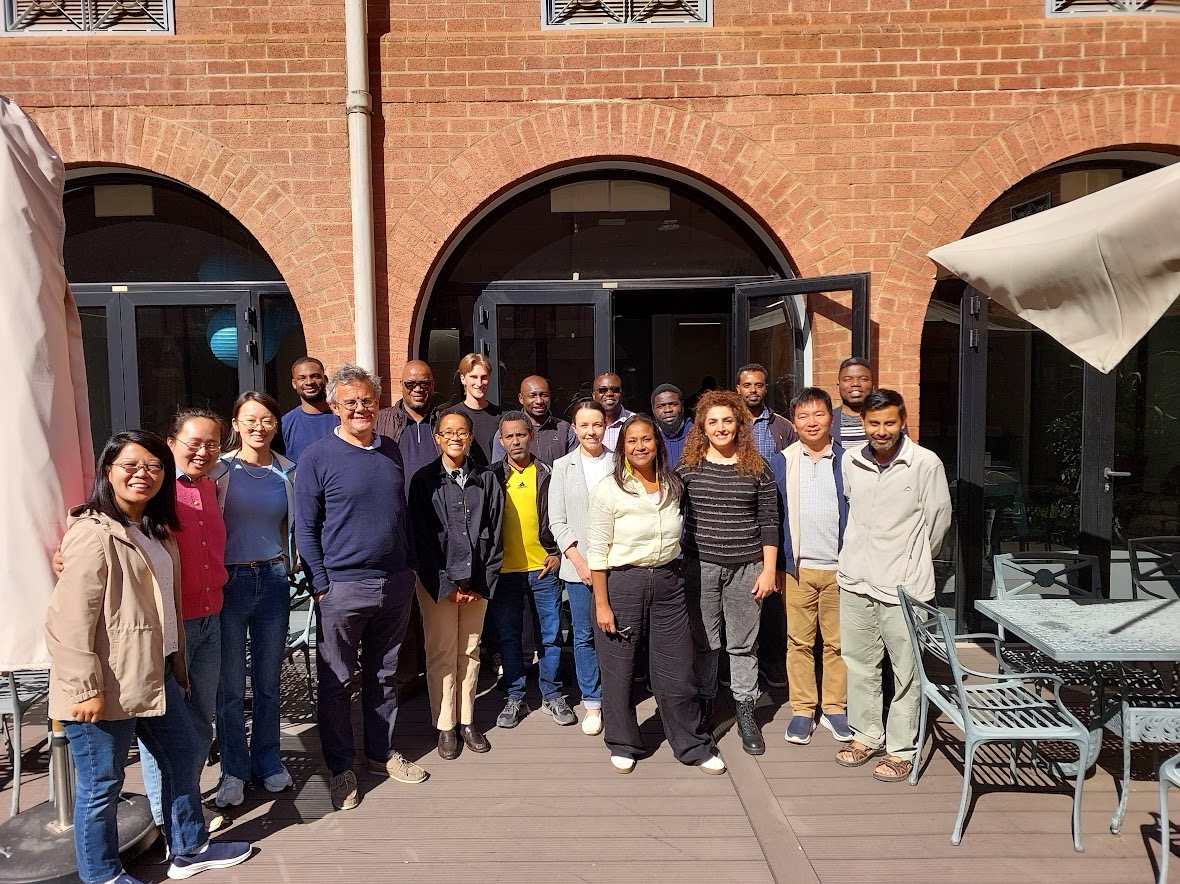
Image: Participants of the “Probabilistic Machine Learning” short course on campus at the University of Pretoria.
Manala Tyobeka, a PhD student with DSFSI at the University of Pretoria, shares her reflection on a two-day short course on probabilistic machine learning.
I recently spent two days (19–20 August 2026) on campus, at the University of Pretoria, attending Probabilistic Machine Learning, a short course taught by Dr David Ríos Insua (ICMAT-CSIC and the Royal Academy of Sciences). The course moved through six lessons: starting with Bayesian conjugate models, moving to regression and dynamic linear models, then computational methods for Bayesian inference, Bayesian neural networks, and finally a case study on colorectal cancer screening that doubled as an introduction to probabilistic graphical models.
What I appreciated most about the two days was a shift in framing. A lot of the machine learning work that we do is oriented around either minimising some cost function, or maximising some accuracy metric — squeezing the most performance out of any model we’re training. The Bayesian perspective asks a different question: how do we model uncertainty itself, so that we can have an honest picture of what our model can and can’t tell us? That’s a subtle, but important reframing. It’s not just about being right more often, it’s about knowing how much to trust the answer you’ve got.
That lens connects to something I’ve been exploring: using latent variable models to meta-evaluate automatic evaluation metrics for machine translation, like BLEU or COMET. Instead of trusting a metric’s score outright, we treat it as a noisy proxy for something we can’t observe directly, i.e., how hard a piece of text actually is to translate, or how good a model really is. The interesting question is why metrics disagree on translation quality, and a latent variable model can help surface that. Variational inference is how we’d fit these models at scale. It can turn inference into an optimisation problem, instead of relying on slower sampling methods. This course gave me a first real handle on this method, which I’ll be spending more time with.
Two days of dense material is a lot to take in, but it was worth every bit of the overload. Thank you to the team from the BRAiN-XTRM Lab for organising the course. If there’s a takeaway beyond the technical content, it’s this: take a chance on the opportunities that the university and lab put in front of you. You won’t always leave with everything fully worked out, but you’ll leave with more than you came in with.
Follow our journey:
- DSFSI: https://linktr.ee/dsfsi
- AfriDSAI: https://linktr.ee/afridsai