Ideas Must Travel: How TextAugment, Community, and Collaboration Won at the "Science Oscars"
Image: Prof. Vukosi Marivate receiving the inaugural NSTF-SADiLaR Research Software Award for Human Language Technologies on stage at the NSTF-South32 Awards.
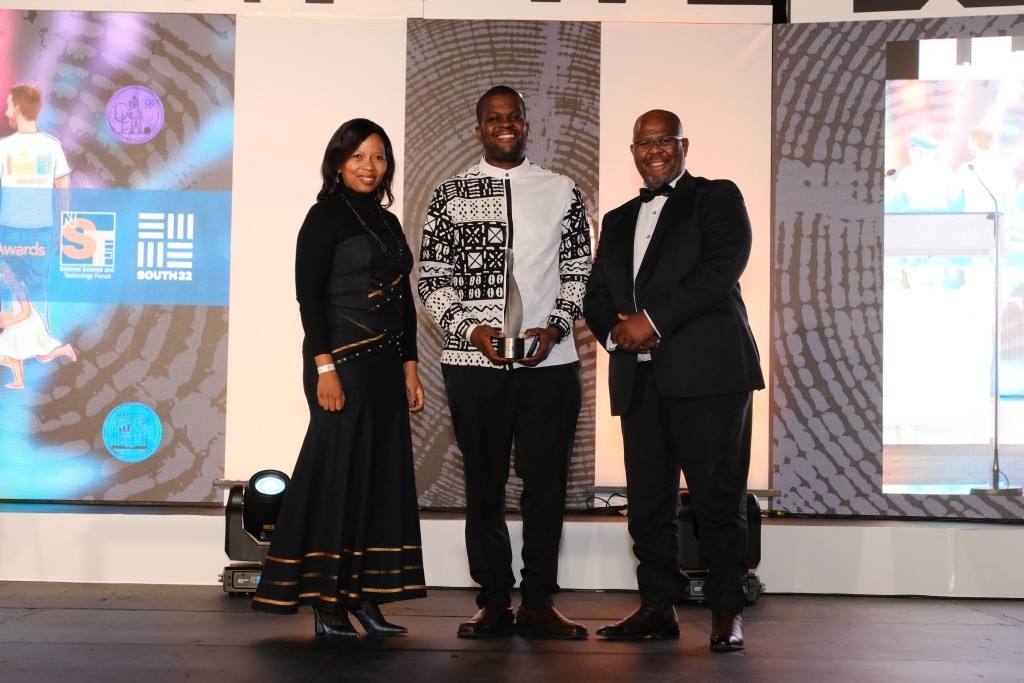
Image: Prof. Vukosi Marivate receiving the inaugural NSTF-SADiLaR Research Software Award for Human Language Technologies on stage at the NSTF-South32 Awards.
In the world of academic research, we often talk about milestones in terms of papers published, citations gathered, or grant funding secured. But last night, our team at the Data Science for Social Impact (DSFSI) lab experienced a milestone of a completely different scale.
At the annual NSTF-South32 Awards—affectionately known as the “Science Oscars” of South Africa—the TextAugment team walked away with the inaugural NSTF-SADiLaR Research Software Award for Human Language Technologies (HLT).
If you missed the live broadcast, you can watch the exact moment our team received the trophy here on the NSTF YouTube Broadcast at 03:25:46.
This award is a massive honor for our lab, but more importantly, it is a validating moment for the entire Human Language Technology and Natural Language Processing (NLP) community in South Africa and across the African continent.
The Spark: What is TextAugment?
One of the biggest hurdles in training robust machine learning models for low-resource languages (like isiZulu, Sesotho, or Yoruba) is data scarcity. Traditional AI models require mountains of clean, labeled data to perform well. If that data doesn’t exist, these languages are effectively locked out of the modern AI revolution.
This is where TextAugment comes in.
Developed as an open-source library, TextAugment focuses on generating synthetic training data to help build more robust machine learning models for under-resourced languages. What started as a focused research tool has grown into a vital piece of global language infrastructure:
- 📈 2,000 to 3,000 downloads every single month.
- 🚀 Over 284,000+ lifetime downloads since its launch in 2019.
- 🌍 Used globally to improve machine learning pipelines in languages ranging from Swahili to Arabic to Uzbek.
You can explore the code, contribute, or implement it in your own projects on our GitHub repository.
A Beautiful, Full-Circle Nominations Stage
What made the night exceptionally sweet was looking across at our fellow nominees in this inaugural category. The other finalist was Dr. Herkulaas Combrink and his team from the University of the Free State (UFS), nominated for their pioneering and incredibly vital work on South African Sign Language (SASL).
This was more than just a friendly competition; it was a proud family reunion. Herkulaas was co-supervised by Prof. Vukosi Marivate during his academic journey.
To stand on a national stage side-by-side with a former student and collaborator—both of us championing linguistic equity in different, yet equally critical, areas of language technology—was the ultimate proof of our core philosophy.
Ideas must travel, and they travel best when we invest deeply in the people carrying them.
Why the “Research Software” Category Matters
For a long time, the academic system has struggled to recognise software development as “core” research. Code was often treated as a byproduct of a paper, rather than a primary research output in its own right.
But as the chairperson of the NSTF noted during the gala, software is the invisible engine enabling modern groundbreaking research across all scientific fields—including the humanities and social sciences.
By partnering with the South African Centre for Digital Language Resources (SADiLaR) to launch this new award category, the NSTF has sent a clear message: the software tools we build to study, preserve, and revitalize our languages are critical scientific infrastructure.
Our Deepest Gratitude
An achievement like this is never the work of a single person. It is the result of an ecosystem that began with a spark of inspiration and grew through continuous collaboration.
Our deepest gratitude goes out to:
- Tshephisho Sefara (CSIR) and Isheanesu Dzingirai (UP), whose tireless work has kept the TextAugment engine running and evolving.
- The CSIR, which provided the initial ignition spark for this project, and AIMS South Africa for hosting the pivotal research software workshop where these ideas first crystallised.
- The ABSA UP Chair of Data Science for their foundational and continued support of our research.
- Dr. Herkulaas Combrink (UFS), a proud UP Alumnus, who played a vital role in our early journey.
- Our colleagues, department, and leadership at the University of Pretoria for fostering an environment where socially impactful AI research can thrive.
We also owe an immense debt of gratitude to our families. The late nights, the times away from home, and the cognitive load of chasing these milestones are heavy, and we could not do any of this without your patience and love.
A Vision for the Continent: The AfriDSAI Platform
This award is not a finish line; it is a catalyst.
We are incredibly proud of the grassroots African NLP community. Across the continent, researchers are using our tools, creating their own, and actively fighting against digital language extinction. Our collective mission remains clear: to build robust, equitable language infrastructure for all.
As we look to the future, we hope to scale this impact through our newly established platform: the African Institute for Data Science and AI (AfriDSAI) at UP. AfriDSAI is designed to serve as a hub for researchers across UP, South Africa, and the broader continent to build a unified ecosystem dedicated to scientific excellence and real-world societal impact.
To the entire TextAugment team, our collaborators, and the global community of researchers using our library—this award is for you. Let’s keep building.
To read more about all the incredible winners from this year’s awards, check out the official NSTF Current Winners page.
Stay connected with our work:
- DSFSI: https://linktr.ee/dsfsi
- AfriDSAI: https://linktr.ee/afridsai