The DSFSI Lab AI Manifesto: 8 Rules for Research in an AI Era
AI tools can now draft our code, summarize our papers, and even suggest our hypotheses. That convenience comes with a quiet risk: it’s easy to outsource the thinking that makes research worth doing in the first place.
AI tools can now draft our code, summarize our papers, and even suggest our hypotheses. That convenience comes with a quiet risk: it’s easy to outsource the thinking that makes research worth doing in the first place.
To keep ourselves honest as a lab, we’ve written down eight rules that guide how we use AI in our research. This is the DSFSI Lab AI Manifesto.
8 Rules for Research in an AI Era
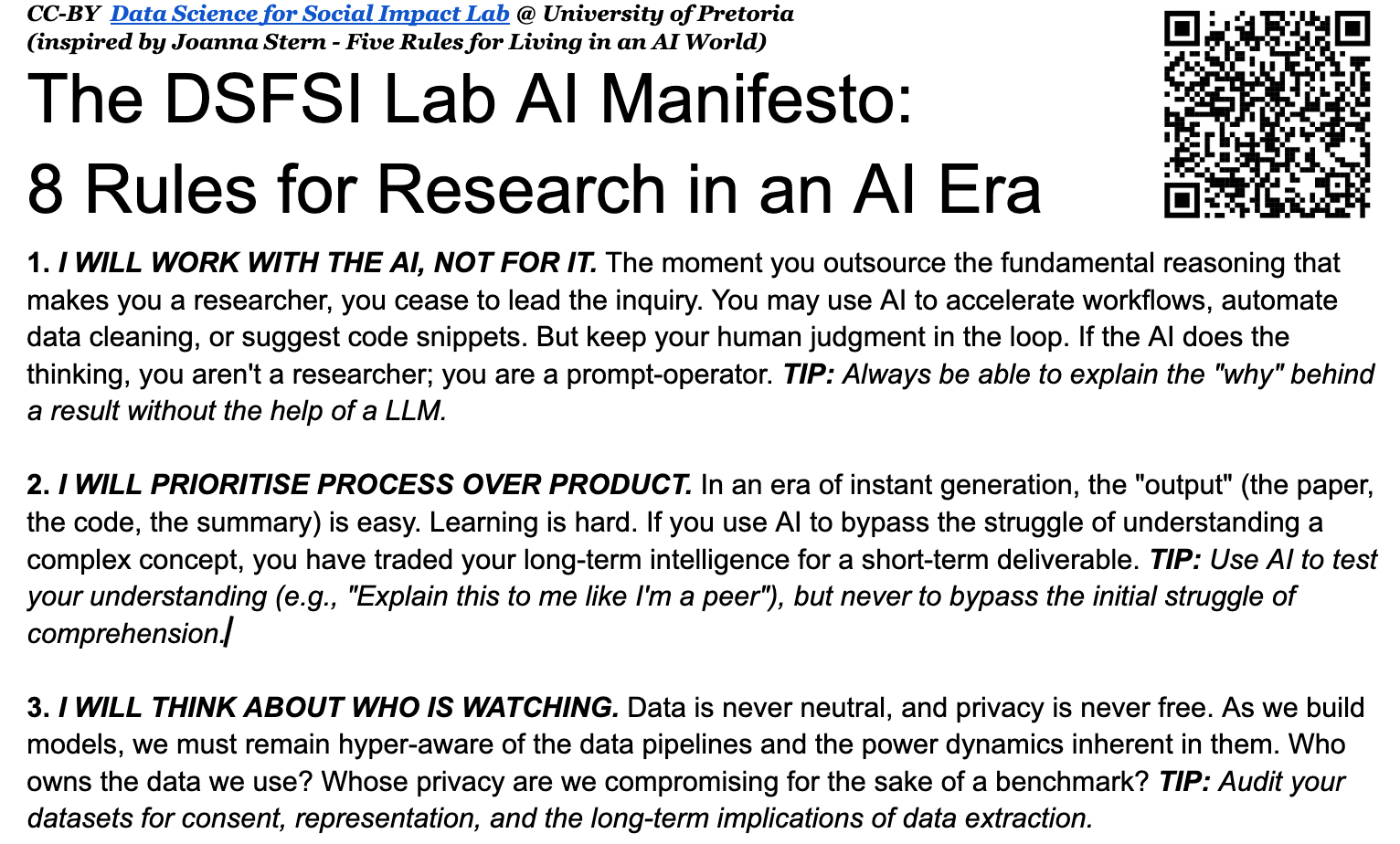
1. I will work with the AI, not for it. The moment you outsource the fundamental reasoning that makes you a researcher, you cease to lead the inquiry. You may use AI to accelerate workflows, automate data cleaning, or suggest code snippets. But keep your human judgment in the loop. If the AI does the thinking, you aren’t a researcher; you are a prompt-operator. TIP: Always be able to explain the “why” behind a result without the help of an LLM.
2. I will prioritise process over product. In an era of instant generation, the “output” (the paper, the code, the summary) is easy. Learning is hard. If you use AI to bypass the struggle of understanding a complex concept, you have traded your long-term intelligence for a short-term deliverable. TIP: Use AI to test your understanding (e.g., “Explain this to me like I’m a peer”), but never to bypass the initial struggle of comprehension.
3. I will think about who is watching. Data is never neutral, and privacy is never free. As we build models, we must remain hyper-aware of the data pipelines and the power dynamics inherent in them. Who owns the data we use? Whose privacy are we compromising for the sake of a benchmark? TIP: Audit your datasets for consent, representation, and the long-term implications of data extraction.
4. I will protect the “slow thinking” space. Deep insights rarely come from rapid-fire prompting. They come from “slow thinking” — the deliberate, messy, unhurried process of synthesis. AI is built for speed; research requires depth, search, and critique of different literatures, not just copy, paste, and paraphrase. TIP: Keep a physical notebook. Sketch architectures, write out logic flows, and draft hypotheses with pen and paper before touching a keyboard. Give your brain the friction it needs to build permanent neural pathways.
5. I will keep building my own training data. Your unique observations, your field notes, and your lived experiences in the community are the only data points that cannot be scraped from a server. Do not let your expertise become a derivative of a pre-trained model. TIP: Prioritise primary research and ethnographic observation. Your “ground truth” should come from the real world, not just a digital proxy.
6. I will value human friction. AI is designed to be frictionless, but scientific progress often requires the friction of human debate, disagreement, and messy collaboration. A chatbot will rarely challenge your fundamental assumptions; a colleague will. TIP: Seek out intellectual conflict. Debate your findings with humans. The most profound breakthroughs happen in the heat of interpersonal discourse.
7. I will practice radical skepticism. In NLP, “hallucination” is a feature, not a bug. Treat every AI-generated insight, citation, or summary as a hypothesis that requires rigorous empirical verification. Never assume a model is “correct” simply because it is confident. Verify and benchmark your results against the existing body of knowledge, and if your results are far off, be able to rigorously explain why. TIP: Verify the “unverifiable.” If an AI cites a paper, find the paper. If it explains a concept, check it against a textbook.
8. I will design for social impact, not just accuracy. A model can be mathematically “accurate” while being socially catastrophic. Our goal is not just to minimise loss functions, but to minimise societal harm. We do not build for the sake of the model; we build for the sake of the people the model affects. TIP: Before deploying or publishing, ask: “Who does this model exclude, and who does it inadvertently empower?”
This manifesto isn’t a set of restrictions on using AI — it’s a commitment to staying researchers, not prompt-operators, as these tools become part of everyday practice. We’ll keep revisiting it as the field moves.
Read, comment, or download the manifesto as a PDF via our Google Doc.
© Data Science for Social Impact Lab, University of Pretoria. Licensed under CC-BY. Inspired by Joanna Stern’s “Five Rules for Living in an AI World.”