Deep Learning Indaba 2026 Reflection: Day 4
Image: Dr Seani Rananga at the Deep Learning Indaba 2026 in Lagos, Nigeria.
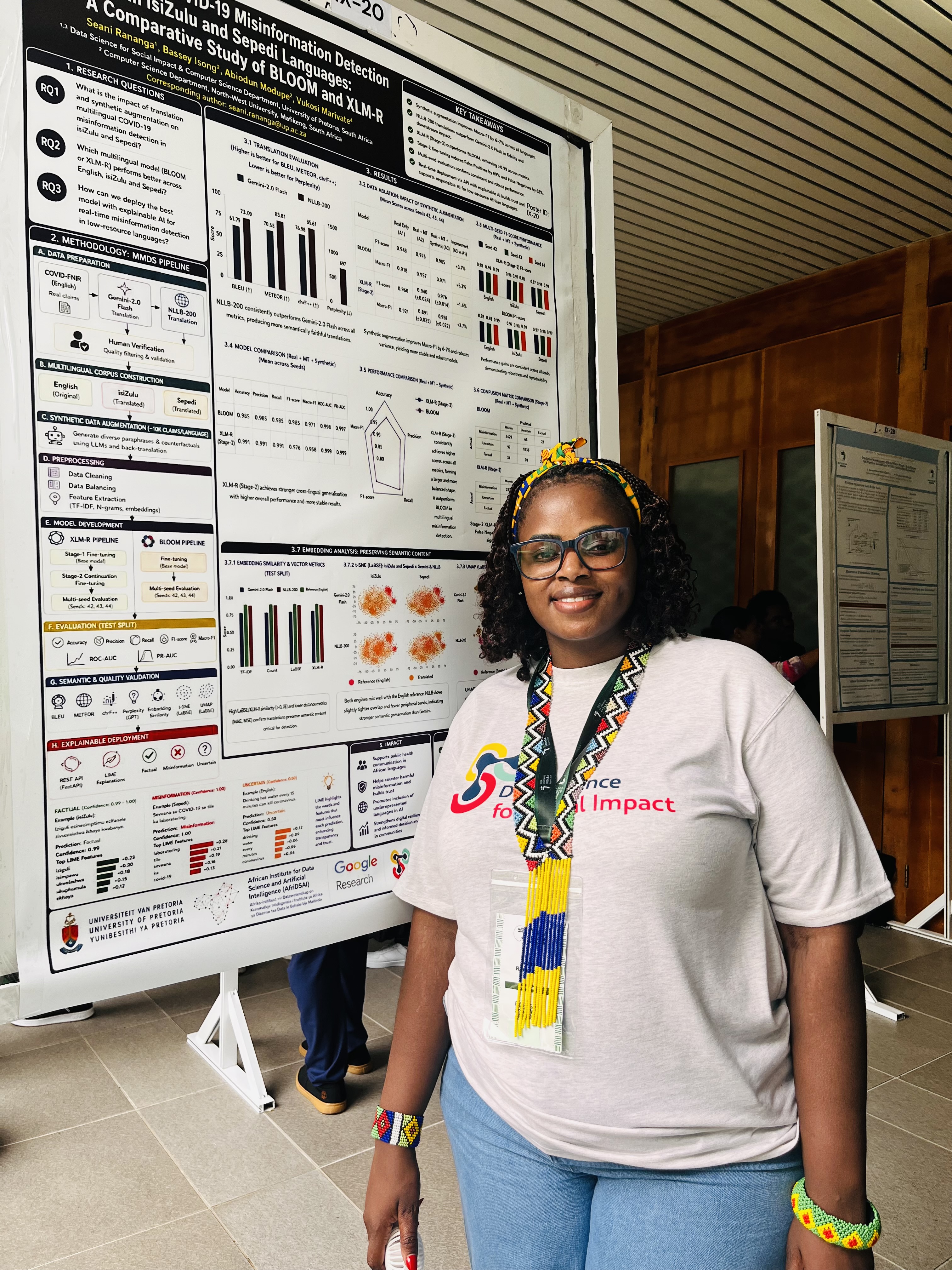
Image: Dr Seani Rananga at the Deep Learning Indaba 2026 in Lagos, Nigeria.
Dr Seani Rananga is attending the Deep Learning Indaba 2026 in Lagos, Nigeria. Here is her reflection from Day 4 of the conference.
Day 4 of the Deep Learning Indaba was another inspiring day of learning, sharing research, and celebrating the growing African AI ecosystem.
The morning began with an insightful keynote by Prof. Vukosi Marivate titled “Rethinking AI Benchmarks for African Languages.” He challenged us to rethink what our AI benchmarks actually measure, arguing that evaluation for African languages must go beyond global standards to reflect our linguistic diversity, dialects, cultural context, and oral traditions. It was a timely reminder that meaningful progress in African AI requires evaluation methods that truly represent the communities we aim to serve.
One of the standout sessions today was the Community Session, celebrating the grassroots AI communities that are expanding access to AI education, building local capacity, and creating opportunities for the next generation of researchers and practitioners. Hearing from community leaders including Kadidja Janny Pombot Fall, Rahma Boghale, Lauriane Mbagdje Dorenan, Samkelo Msibi, Dr. Brando Okolo, Faruq Afolabi, Favour Falade, Victor Ogundele, Aanu Oyeniran, Chinonyelum Rosemary Igwe, Petra Agien, Gilles Quentin Hacheme, and moderator Paul Kennedy highlighted the importance of collaboration, sustainability, and investing in local AI ecosystems across Africa.
The conference also reflected on the success of Research in Africa Day, which showcased more than 200 research presentations across IndabaX chapters, spotlight papers, African datasets, and general AI research. It was inspiring to see the depth, diversity, and impact of AI research taking place across the continent.
The highlight of my day was presenting my PhD research poster on multilingual misinformation detection in isiZulu and Sepedi, using COVID-19 as a pilot study. It was a privilege to discuss my work with researchers from across Africa and receive valuable feedback and thought-provoking questions.
My research presents a multilingual misinformation detection framework that explores:
- Machine translation for low-resource African languages
- Synthetic data generation to improve model performance
- Translation quality evaluation before downstream learning
- Embedding analysis to assess semantic representations
- Data ablation studies and multi-seed experiments for robust evaluation
- Fine-tuning and evaluating language models for misinformation detection
- Explainable AI using LIME, allowing the model to explain not only its predictions but also the reasoning behind them
- A prototype multilingual framework that demonstrates how AI can support misinformation detection in African languages
Every discussion today reinforced how much innovation is happening across Africa and how powerful collaboration can be in solving challenges that matter to our communities.
Grateful for another incredible day at the Deep Learning Indaba and looking forward to what the rest of the week has in store.
Follow our journey at Deep Learning Indaba 2026 and beyond:
- DSFSI: https://linktr.ee/dsfsi
- AfriDSAI: https://linktr.ee/afridsai