AfirkaLLM Part 4: What is still missing, and where you come in
The biggest gap is data that was never online. If you speak an African language or hold text in one, this part is for you.
The biggest gap is data that was never online. If you speak an African language or hold text in one, this part is for you.
This is part 4 of a four-part series: 1. Where the data comes from, 2. What the experiment found, 3. Compute and terms, 4. What is missing and how to help.
We have grown the web’s African footprint, built and cleaned a corpus, chosen the model on evidence, and run the experiment that tells us how to train it (Parts 1 to 3). Here is the honest limit of what any of that can do on its own: the biggest thing still missing is data, and most of the data that is missing is not on the internet.
About 18.6 billion tokens is far too little for a model that is meant to represent our languages. That is the whole finished harvest, and the training mix for our 40 focus languages is drawn from it. The general-purpose models we start from are pre-trained on trillions of tokens; our entire African harvest is under one percent of that. Half of it is two languages, and 173 of its 256 languages have under a million tokens each. Even complete, it is still the same kind of text: web pages, and the web is where our languages are thinnest. The experiment in Part 2 shows the shape of the problem: more of the same web text does not recover what the model forgets, and the gains it does buy are patchy from one language to the next. What we need is text the web has never seen.
- Text that was never online, for continued pre-training. Books, newspapers and magazines, school textbooks and readers, government gazettes, court records, radio and television scripts, transcribed oral histories, dictionaries and grammars, theses, and agricultural and health leaflets. Scanned, typed, or still on paper. This is what the model needs most, and it is the data nobody can crawl.
- Text that teaches the model to answer, for instruction tuning. Questions with answers, exam papers with marking guides, translated instructions, and conversations and summaries. This stage is starved even more than pre-training.
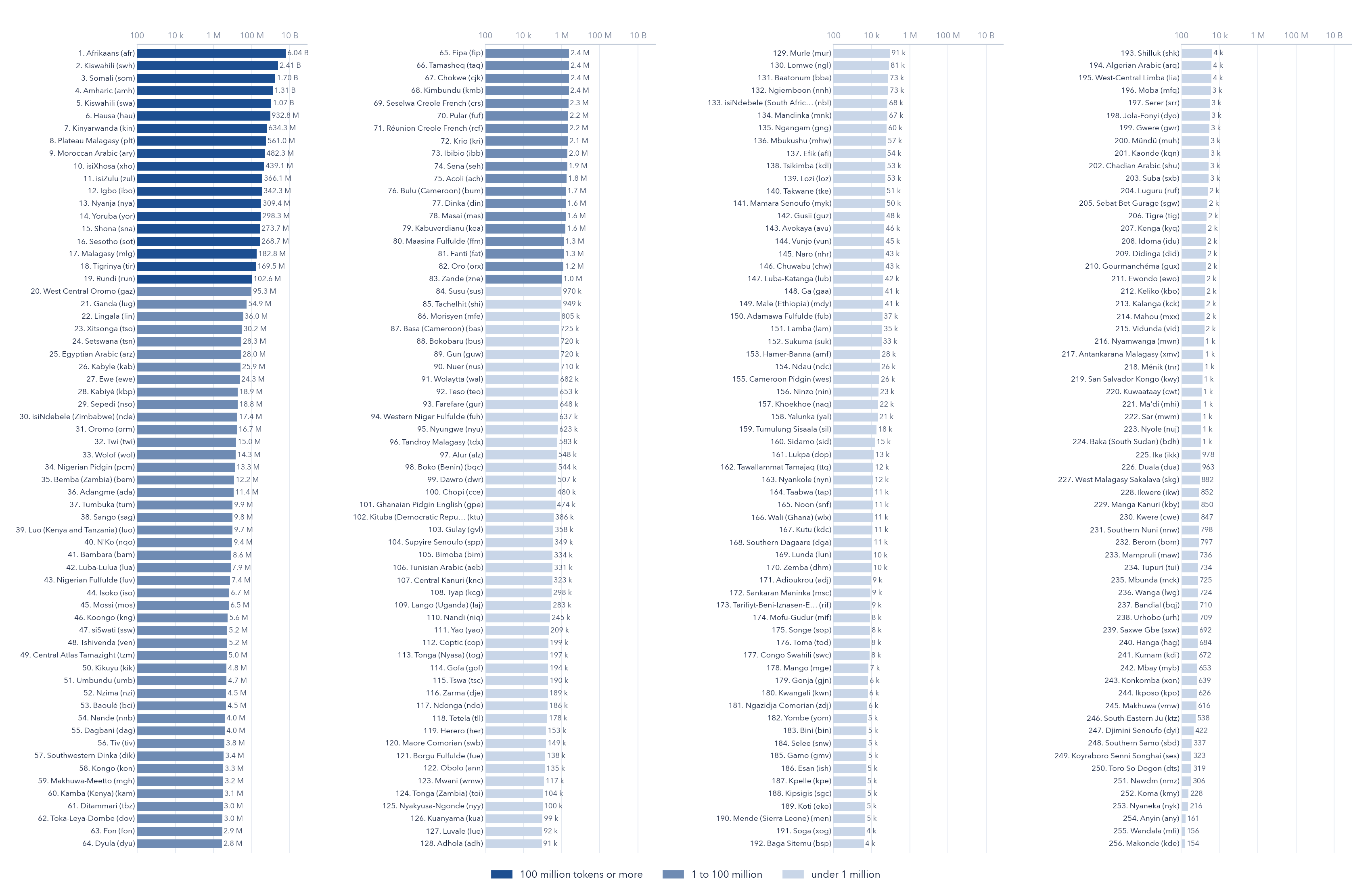
- Data in the languages the web under-represents. Find your language in our chart of all 256 languages in the harvest below. If it has under a million tokens, your data matters most.
Figure 1. Find your language. All 256 languages in the harvest, ranked by how many tokens of text we hold for each (log scale). Dark blue: 100 million tokens or more; mid blue: 1 to 100 million; light blue: under 1 million. Click the chart to open it full size.
Whatever you hold, it stays yours and is used on your terms, as Part 3 sets out. To offer it, register at app.afirkallm.org/apply and tell us what you have, in any format. If it exists only on paper or in an archive, say so, and we will work out with you how to bring it in.
From speaking to following instructions
The pre-training corpus from Part 1 teaches the model to speak. A second body of data teaches it to follow instructions, the stage that comes after continued pre-training. Here we draw on two streams. The first, and the one we lean on hardest, is community data: the real, human-made datasets that African NLP researchers and speaker communities have built over years, which we gather rather than replace. Masakhane’s MAFAND-MT news-translation corpus, community translation and speech collections, and classification and question-answering sets: we have brought 439 such datasets into a single, license-tracked catalog, each credited to the people who made it. Gathering them into one place, with their provenance intact, is itself part of the contribution. Of that catalog, we have so far downloaded 51 datasets, roughly 39 million records across 39 languages. That raw count is honest but misleading on its own. It is dominated by a handful of very large machine translation sentence-pair sets (one English to Kiswahili set alone is 23 million rows), a reminder that volume is not balanced coverage. The second stream is synthetically generated instruction data written for African settings: 58,634 records across our 40 languages, described below. Every dataset in both streams carries its source and license. Unknown or restrictive licenses are flagged and held back (187 of the 439 so far), and community datasets are used strictly on the terms their creators set. We are still gathering. If your community has built a dataset for an African language, we want to include it, with credit and on your license.
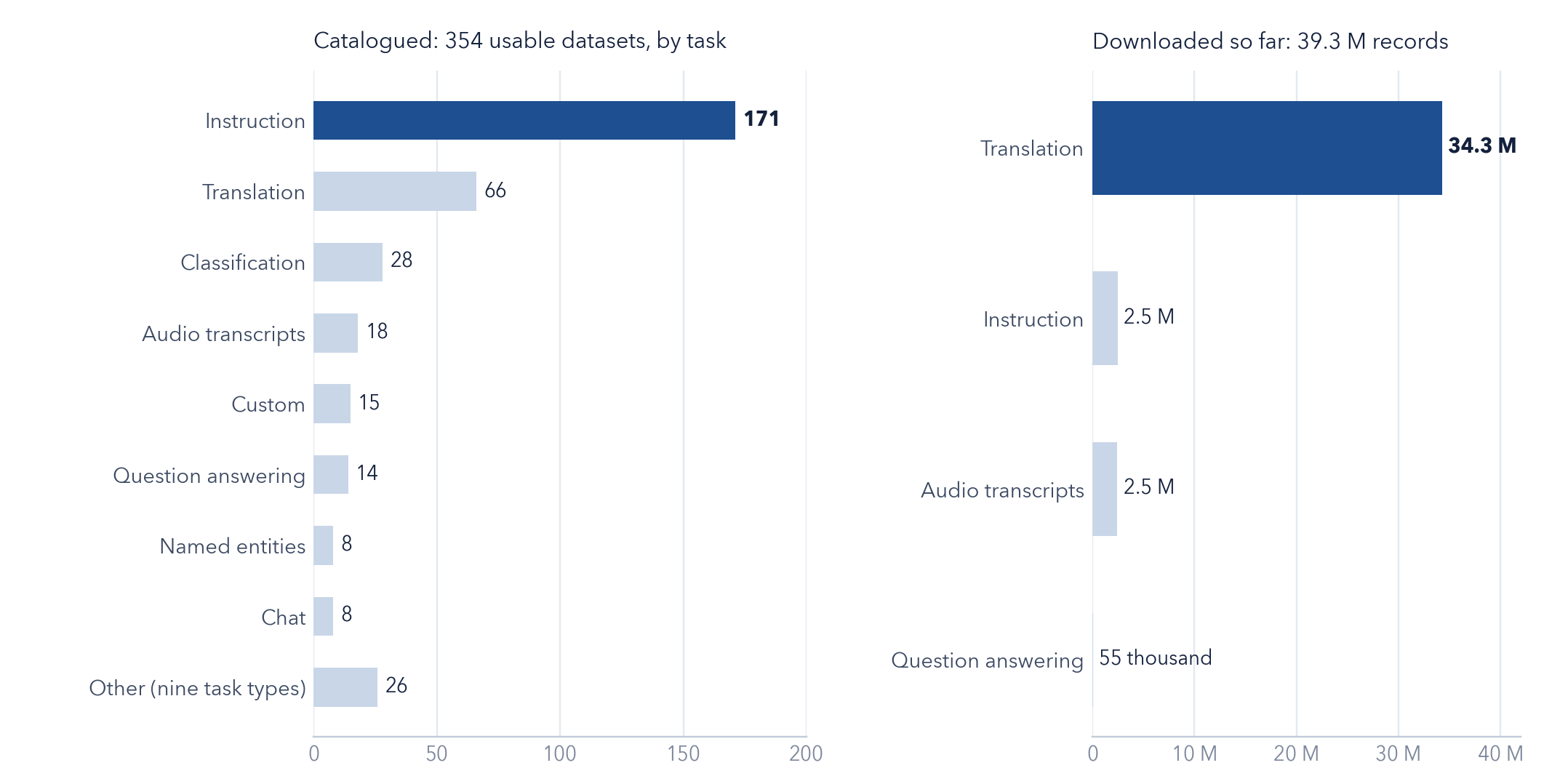
Figure 2. The community catalog is broad; what is downloaded so far is mostly translation pairs. Human-made African-language datasets gathered for instruction tuning: 354 usable datasets by task (439 catalogued, 187 held back for unknown licenses), and the 39.3 million records downloaded so far by task. Record counts include both sides of parallel corpora; one English to Kiswahili set alone is 23.5 million rows.
A machine can gather text and learn patterns, but only a native speaker can tell us whether the result actually sounds right. Whether a translated proverb keeps its meaning. Whether the tone marks are correct. Whether a word that is natural in one variety is wrong in another. That judgment is the thing this whole effort turns on, and it cannot be automated.
Everything we produce is released openly: the corpus, the benchmarks, the platform that runs it all, and the models as they are trained. Already in hand: 58,634 instruction examples written for African settings, and AfriGuard, a 422,375-item safety corpus, the first of its kind for African languages. Six in ten of the instruction examples are question-and-answer triplets; the rest come from a translation pilot, self-instruct generation, code-switching, and cross-lingual pivots, and every strategy covers all 40 languages except code-switching, which covers 37. But the datasets are only as good as the speakers who verify them, and 58,634 examples is a start, not a finish.
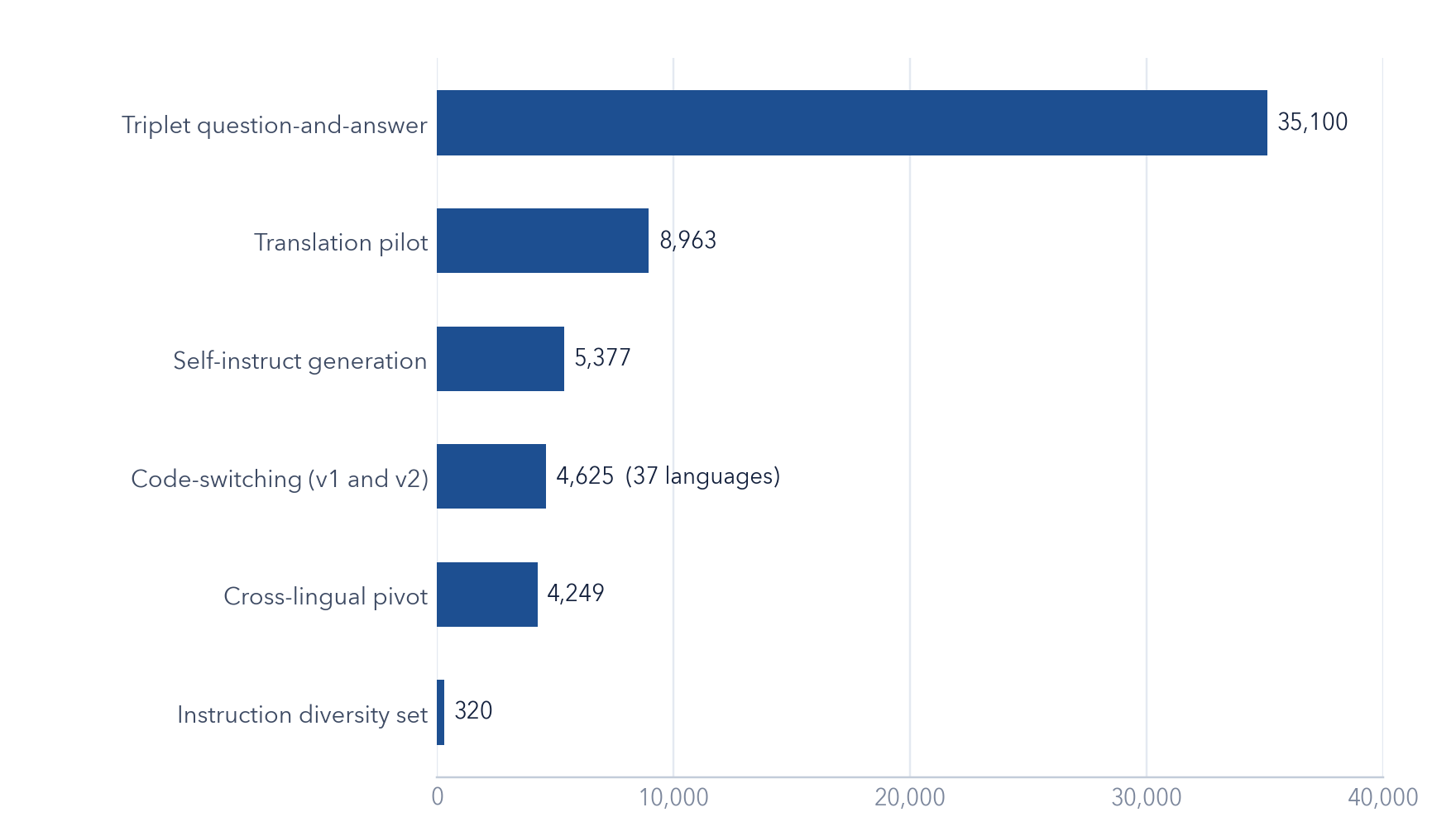
Figure 3. Six in ten instruction examples are question-and-answer triplets. AfirkaLLM instruction-tuning examples by how they were made, 58,634 in total across 40 languages; every strategy covers all 40 except code-switching (37).
AfriGuard: safety grounded in African contexts
AfriGuard is the alignment side of that work. It is a safety corpus of 70,400 prompts and 422,375 candidate responses, of which 310,542 passed every quality filter. It is balanced on three axes at once: 40 languages, 11 harm categories, and 4 severity levels, with 58 subcategories beneath them. The categories cover hate speech and discrimination, gender-based violence and sexual offenses, privacy violations, disinformation and electoral manipulation, financial fraud and economic exploitation, child safety, mental health and emotional harm, harmful medical misinformation, violent extremism and incitement to armed conflict, and harmful instructions, plus a helpful-and-safe category so the model learns what a good answer looks like, not only what to refuse. The prompts are grounded in African documents, named entities, and local legal context. They are not Western safety prompts run through a translator.
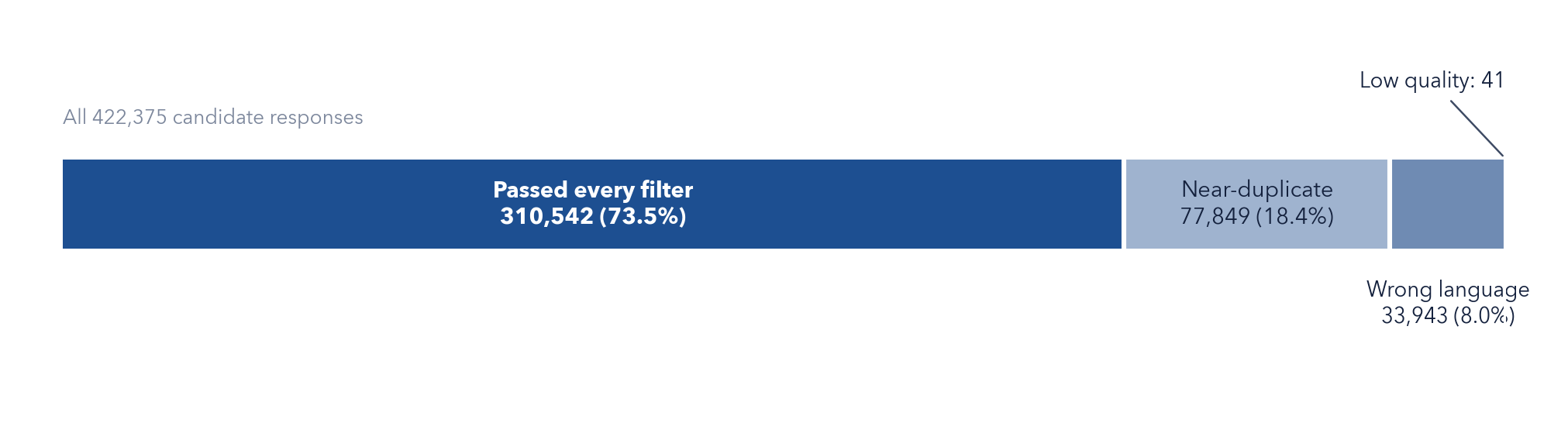
Figure 4. Three in four AfriGuard responses survive the quality filters. 422,375 candidate responses to 70,400 prompts, balanced across 40 languages, 11 harm categories, and 4 severity levels, by filter outcome. Prompts are grounded in African documents, entities, and legal context, not translated from Western safety sets.
What comes next. The full training run on the complete harvest, then instruction tuning on the data above, and then the comparison that matters: the finished model against the one we started from. Everything you bring in before then goes into that model.
Where you come in
If you speak an African language or hold text in one, you can help, and you will be credited for it.
- Bring data. Text in your language that is not on the web, for pre-training, and question-and-answer material, for instruction tuning. Any format, any size, on your terms.
- Share compute. If your lab, company, or cluster has GPU time to spare, even in stretches, it becomes another experiment we can run. Part 3 shows how we fit around other users.
- Verify data. Review samples and confirm they are natural and correct in your language.
- Register your language. Tell us which languages and varieties you can speak for.
- Shape the models. Your review directly decides what the models learn.
- Get credited. Reviewers and contributors are named as authors on the resulting dataset and paper.
It is not a job. It is an open collaboration to make AI work for languages that have waited too long for it. Contribute what you can, when you can.
Read about the project and how you can join to contribute: app.afirkallm.org/#join
Sign up and register your language: app.afirkallm.org/apply
🎥 Watch: LLM Building and Sovereign AI. In 2026 we have also been running a special theme of our Data Science for Society Seminar Series focused on LLM building and sovereign AI. Recordings are available on YouTube: watch the LLM Building and Sovereign AI playlist, and subscribe to the channel so you don’t miss new sessions.
AfirkaLLM is a project of the Data Science for Social Impact lab, University of Pretoria. We build open datasets, models, and tools for 40 African languages, and we would love your help doing it.
This work was primarily human-created. AI was used to make stylistic edits, such as changes to structure, wording, and clarity. AI was used to edit content, such as scope, information, and ideas. AI was prompted for its contributions, or AI assistance was enabled. AI-generated content was reviewed and approved. The following model(s) or application(s) were used: Claude, Gemini.