Harnessing AI for Inclusive and Sustainable Socioeconomic Development
On May 15, 2026, Prof Vukosi Marivate presented a public lecture during the DSTI Budget Vote. The talk centered on a critical reality: while South Africa leads the continent in AI readiness, the “AI Revolution” will not automatically benefit our people without a deliberate, locally-funded foundation.
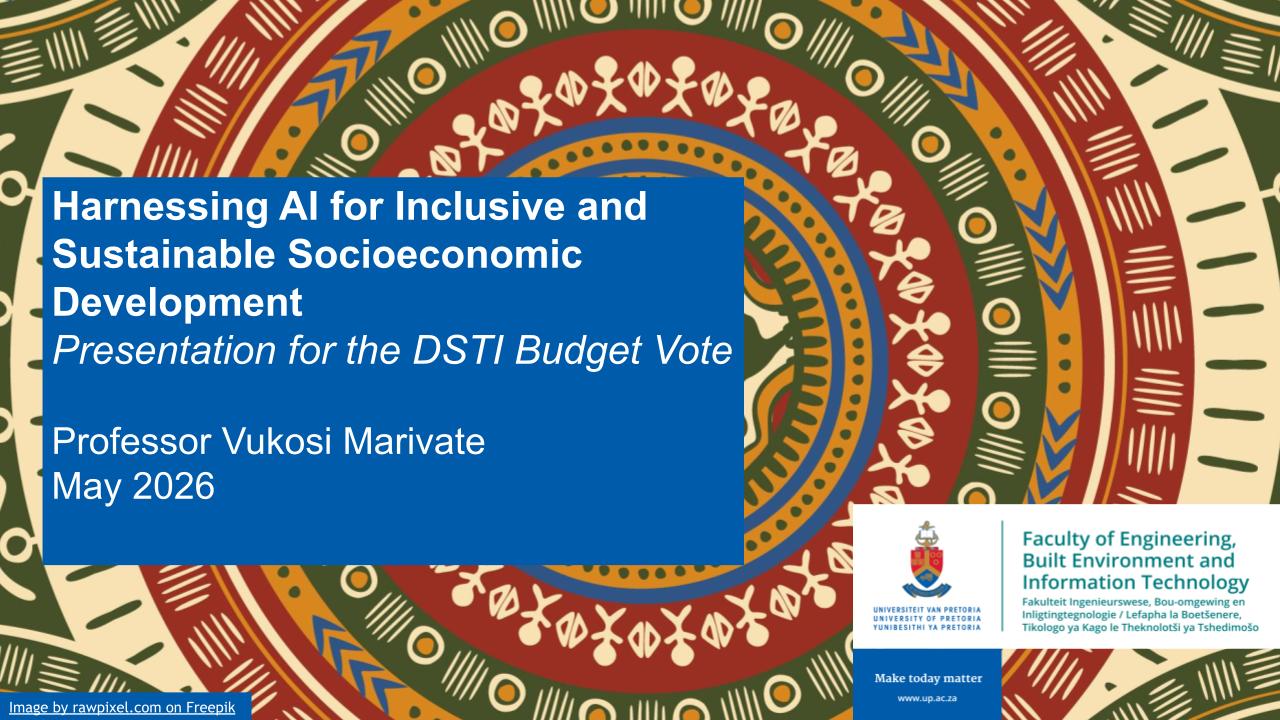
On May 15, 2026, Prof Vukosi Marivate presented a public lecture during the DSTI Budget Vote. The talk centered on a critical reality: while South Africa leads the continent in AI readiness, the “AI Revolution” will not automatically benefit our people without a deliberate, locally-funded foundation.
The Presentation
You can view the full slide deck here: View Slides: Harnessing AI for Inclusive Development
Key Takeaways
1. Technology as a Multiplier (Toyama’s Law)
One of the core themes of the lecture is that AI is not a “magic fix” for social challenges. According to Kentaro Toyama’s Law of Amplification, technology is a multiplicative force. It amplifies existing human intent and institutional capacity.
- If our R&D capacity and education systems are strong, AI will amplify that progress.
- If they are weak, AI will only amplify existing inequalities.
2. The R&D Investment Gap
To move from being “consumers” of AI to “shapers” of it, South Africa must address the current funding disparity.
- The Reality: South Africa currently spends 0.61% of GDP on R&D.
- The Goal: The National Development Plan (NDP) target is 1.5%.
- The Call to Action: We cannot rely solely on the public purse. The private sector must step up to invest in local AI R&D to bridge this gap.
3. A Decade of Grassroots Agency
African AI is not going to build itself. The progress we see today—highlighted by our #1 ranking in AI Talent Readiness (Stanford HAI 2025)—is the result of a decade of work by grassroots movements like the Deep Learning Indaba and Masakhane.
Educational Resources
If this lecture sparked your interest in understanding how AI works or how you can build it, you don’t need a PhD to get started. Here are some of the best accessible resources:
Foundational Learning (No Coding Required)
- AI for Everyone (DeepLearning.AI): Taught by Andrew Ng, this is the gold standard for understanding what AI can and cannot do, and how to spot opportunities to apply it.
- Elements of AI: A brilliant, free online course created by the University of Helsinki designed to demystify AI for the general public.
Open Books & Accessible Reading
- Machine Learning for Everyone (by Vas3k): A brilliantly illustrated, jargon-free online guide that explains how different machine learning algorithms work using simple, real-world analogies.
- Data Feminism (MIT Press Open Access): An open-access book by Catherine D’Ignazio and Lauren F. Klein that perfectly complements Kentaro Toyama’s “Law of Amplification.” It explores how data science can either reinforce inequalities or be used to challenge them—essential reading for understanding inclusive AI.
For Aspiring African Builders
- Zindi Learning: Zindi is the largest network of data scientists in Africa. Their learning section offers tutorials and datasets specific to African challenges.
- Masakhane NLP Resources: For those interested in language technology, explore how this grassroots community builds tools for African languages.
- Fast.ai: If you are ready to write code, this free course is famous for getting beginners building practical, state-of-the-art models quickly.
Further Reading & Organisations
To stay involved with the work we are doing at the University of Pretoria and across the continent, please visit:
- AfriDSAI: The African Institute for Data Science and AI.
- DSFSI Lab: Data Science for Social Impact research group.
- Lelapa AI: An African-centric AI research and product lab. (Disclosure: Prof Vukosi Marivate is a co-founder)
- Deep Learning Indaba: Strengthening African Machine Learning.
- Join our Newsletter: Weekly updates from our research group.