DSFSI 2025 Retrospective (Day 5): Teaching, Training, and Mentoring the Next Generation
Day 5 of our retrospective: How DSFSI is building African AI capacity through postdoctoral seminars, transdisciplinary workshops, and mentorship programs.
Day 5 of our 7-day retrospective celebrating DSFSI’s remarkable 2025 journey.
Teaching, Training, and Mentoring the Next Generation
Research excellence is meaningless if knowledge stays locked in journals. Real impact comes from sharing what we learn, teaching the next generation, and building capacity across the ecosystem.
In 2025, DSFSI invested heavily in knowledge sharing—through seminars, workshops, courses, and collaborations that brought cutting-edge research to students, practitioners, and communities.
🎓 DSFSI Postdoctoral Seminar Series (March)
Our annual Postdoctoral Seminar Series returned in March 2025, showcasing emerging leaders in African AI and Data Science. Each seminar addressed critical challenges in low-resource language technologies with practical, implementable approaches.
Seminar 1: Code-Switching for African Languages
Speaker: Dr. Kayode Olaleye Date: March 5, 2025 Topic: Code-Switched Translation for African Languages
Dr. Olaleye explored the complexities of code-switching and code-mixing—how Africans naturally blend languages in conversation. He presented the Afro-CSX dataset, combining LLM-generated and human-validated samples across:
- Yorùbá
- isiZulu
- Sesotho
- English
Focusing on agriculture and personal finance domains, his team evaluated how code-switched data impacts machine translation performance, revealing both the promise and limitations of synthetic data in low-resource settings.
Key insight: Even small amounts of high-quality code-switched data can significantly improve translation models—but human validation is essential.
Seminar 2: Language Models Across African Languages
Speaker: Dr. Idris Abdulmumin Date: March 12, 2025 Topic: Designing Language Models that Perform Well and Scale on African Low-Resource Languages
Dr. Abdulmumin tackled the gaps in language model performance across African languages, emphasizing:
- Data scarcity challenges
- Tokenization issues (models built for English often “waste” tokens on African languages)
- Evaluation gaps (benchmarks designed for high-resource languages don’t transfer)
His research evaluated how well multilingual LLMs generalize to African languages and proposed new directions for:
- Inclusive model training
- Culturally-informed benchmarks
- Community-led evaluation
Key insight: We can’t just “add African languages” to existing models. We need to rethink architecture, training, and evaluation from the ground up.
Seminar 3: Automatic Speech Recognition for African Languages
Speaker: Dr. Hope Mogale Date: March 19, 2025 Topic: Designing Automatic Speech Recognition Systems that Perform Well and Scale on African Low-Resource Languages
Dr. Mogale closed the series with a practical walkthrough of building ASR systems that handle diverse, noisy, real-world African speech data.
He demonstrated a custom ASR toolkit that supports:
- Dataset loading (Lwazi, NCHLT, Common Voice)
- Model training (with limited resources)
- Speaker diarization (identifying who’s speaking when)
This wasn’t theoretical—it was a blueprint for practitioners to build their own ASR systems.
Key insight: Open tools and modular pipelines make African language ASR accessible to researchers without massive compute budgets.
Series Impact
📺 Full Playlist: DSFSI Postdoctoral Seminar Series 2025
These seminars reached:
- UP students and faculty
- African researchers tuning in remotely
- Practitioners looking for implementable approaches
- Policymakers understanding technical realities
Supported by: University of Pretoria, Microsoft Research Africa, JP Morgan AI, ABSA, and other partners
🏥 Bridging AI and Medical Imaging (June–October)
2025 marked significant expansion into medical AI—demonstrating DSFSI’s commitment to transdisciplinary impact.
Prof. Judy Gichoya’s Visit (June–July)
Prof. Judy Gichoya (McGill University), a leader in medical AI and responsible innovation, spent time with DSFSI and the broader UP community.
Her visit included:
- Research collaborations with DSFSI members
- Seminars on AI ethics in healthcare
- Discussions on bias in medical imaging algorithms
- Pathways for South African researchers to engage with global medical AI
This visit exemplified the transdisciplinary collaboration that AfriDSAI is designed to enable—bringing together computer science, medicine, ethics, and public health.
Read about Prof. Gichoya’s visit
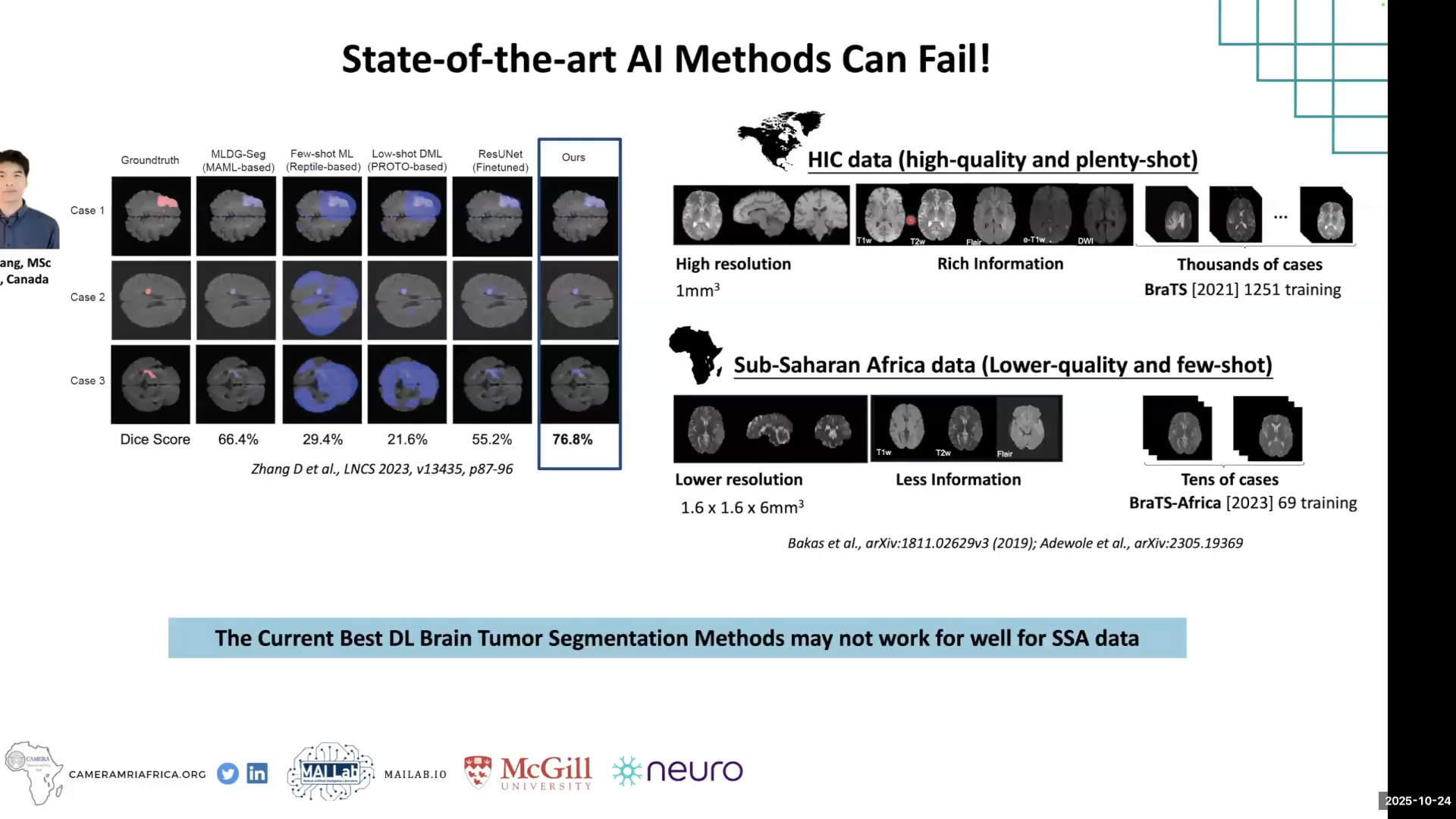
Dr. Udunna Anazodo: Bridging the AI in Medical Imaging Divide (October 24)
Dr. Udunna Anazodo (McGill University, Assistant Professor; Founder of CAMERA; Scientific Director of MAI Lab) delivered a vital seminar on implementing AI in medical imaging across Africa.
Co-hosted by AfriDSAI and SisonkeBiotik, the seminar addressed:
Structural barriers to AI adoption:
- Infrastructure scarcity: Lack of data centers and HPC across many African regions
- Model generalizability: Western-trained models often fail on African populations, leading to clinical risks
Innovative solutions:
- SPARK Academy: “Train-the-trainer” program that has educated ~700 individuals over three years
- CPU-optimized tutorials: Enabling AI training on standard hardware (not just expensive GPUs)
- MAI Lab in Lagos: Africa’s first AI lab within a private radiology practice, enabling “bench-to-bedside” development
- Neuron infrastructure: Upcoming HPC access for African researchers
Key insight: For medical AI to work in Africa, it must be validated by and ideally built by Africans—ensuring clinical relevance and trust.
📚 Courses and Workshops
MIT808: Advanced Data Science
DSFSI members taught MIT808, exposing postgraduate students to cutting-edge data science methods, African language NLP case studies, and ethical AI frameworks.
Data Science and AI Workshop
Practical workshops brought AI and data science education to broader audiences, emphasizing:
- Hands-on coding
- Real-world datasets
- Ethical considerations
- Career pathways in African AI
📖 Building Resources: The Digitisation Library
In July, we launched a library of DSFSI research abstracts—making our work more discoverable and accessible to students, journalists, policymakers, and the public.
This library democratizes access to:
- Summaries of complex research
- Links to full papers and code
- Contact information for collaborations
💡 Why Knowledge Sharing Matters
Capacity building isn’t charity—it’s infrastructure.
Every seminar trains a researcher who’ll build the next dataset. Every workshop introduces a student who’ll lead the next lab. Every open resource becomes a foundation for someone else’s breakthrough.
In resource-constrained settings, knowledge hoarding is a luxury we can’t afford. Open sharing accelerates everyone.
📊 By the Numbers: 2025 Capacity Building
- 3 postdoctoral seminars with recordings reaching global audiences
- 2 major medical AI events (Gichoya visit + Anazodo seminar)
- Multiple workshops on data science, AI, and African languages
- Graduate courses teaching next-generation researchers
- 700+ people trained through SPARK Academy (via Dr. Anazodo’s work)
- Thousands reached through YouTube, blog posts, and newsletters
🌍 The Ripple Effect
When Dr. Hope Mogale teaches someone to build an ASR system, that person might:
- Build speech recognition for their local language
- Train students at their institution
- Contribute to open-source projects
- Start a company serving their community
That’s the ripple effect. That’s how movements grow.
Tomorrow (Day 6): We celebrate our students—the PhD graduates, Masters scholars, Honours achievers, and undergraduates who are DSFSI’s future.
Related Posts:
- March Recap + DSFSI Postdoctoral Seminar Series
- Prof. Judy Gichoya’s Visit
- Bridging the AI in Medical Imaging Divide in Africa
- MIT808 Course
Watch the Seminars:
Stay connected:
- 🌐 Website: dsfsi.co.za
- 🐦 Twitter/X: @dsfsi_research
- 💼 LinkedIn: DSFSI
- 📬 Newsletter: DS@UP on Substack
This is Day 5 of our 7-day retrospective. Tomorrow we celebrate the students who graduated in 2025 and the next generation of African AI researchers.
#DSFSI2025 #CapacityBuilding #KnowledgeSharing #AfricanAI